

Robotics 101 – Master the First Principles of Robotics (Ubicoders)
Robotics 101 – Master the First Principles of Robotics (Ubicoders) is a deep, engineering-focused program designed to teach you how to build autonomous systems from scratch using control theory, sensor fusion, and real-world physics.
This course focuses on one critical transformation:
👉 from copying code… to understanding and building robotic systems from first principles
Instead of relying on black-box libraries or frameworks, you’ll learn how robotics actually works at the mathematical and system level—giving you the ability to design, debug, and control real-world systems.
What’s Included on Robotics 101 – Master the First Principles of Robotics (Ubicoders)
Inside this program, you get a complete robotics engineering system:
- First-principles robotics training (Math → Code → Reality)
- Control systems and sensor fusion frameworks
- Virtual robots for real-time testing
- End-to-end autonomous system development
- Hands-on coding and simulation exercises
- Lifetime access to structured curriculum
Core Learning Philosophy
This course is built around:
- No black boxes → understand every system component
- Math-first approach → equations before implementation
- Simulation + real behavior validation
- Engineering mindset over copy-paste coding
Course Curriculum (Full Breakdown)
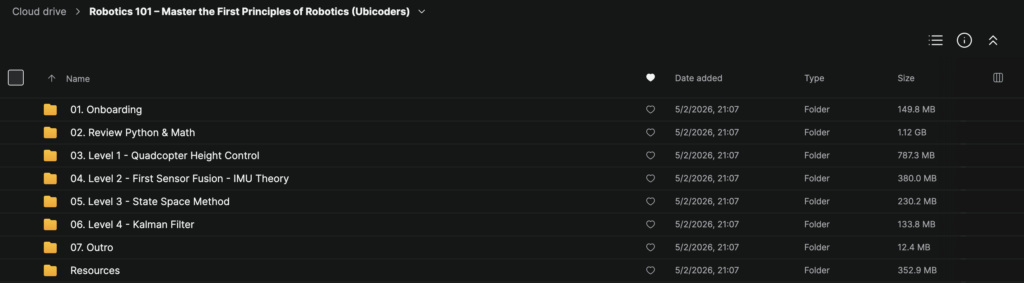
Foundations: Math & Programming
- Linear algebra, calculus, and statistics
- Differential equations and system modeling
- Python fundamentals for robotics
- Eigenvalues, vectors, and transformations
Core Robotics Concepts
Control Systems
- PID control (multi-stage systems)
- Cascade PI controllers
- Real-time system stabilization
Rotation & Coordinate Systems
- Rotation matrices (core robotics language)
- Coordinate frame transformations
- Real-world sensor alignment
Sensors & Data Processing
- Accelerometer, gyroscope, magnetometer
- Inertial Measurement Units (IMU)
- Noise filtering techniques (low-pass, averaging)
Level-Based Learning System
Level 0: Core Tools
- Data collection and visualization
- Real-time graphing
- Virtual robot environments
Level 1: Quadcopter Control
- Altitude (height) control
- Velocity and rate control
- Full system capstone
Level 2: Sensor Fusion
- Direction Cosine Matrix (DCM)
- IMU data integration
- Multirotor orientation systems
Level 3: State-Space Systems
- State-space modeling
- Control theory implementation
- Nonlinear system behavior
Level 4: Kalman Filter
- Kalman filter theory and code
- Extended Kalman Filter (EKF)
- Real-world sensor fusion systems
Key Topics Covered
- Kalman Filters (core robotics concept)
- Sensor fusion and IMU systems
- State-space control methods
- Rotation matrices and transformations
- Noise filtering and signal processing
What Makes This Course Different
Most robotics courses teach tools.
This one teaches how systems actually work.
Key advantages:
- Built on first principles (not shortcuts)
- Focus on real engineering understanding
- Combines math, code, and real behavior
- Includes simulation environments
- Designed for deep technical mastery
Key Benefits
- Understand robotics at a fundamental level
- Build systems without relying on libraries
- Develop strong engineering intuition
- Improve problem-solving skills
- Prepare for real-world robotics roles
Who This Course Is For
- Engineering students
- Robotics and AI developers
- Software engineers entering robotics
- Technical learners wanting deep understanding
- Anyone serious about autonomous systems
About Ubicoders
Ubicoders focuses on teaching robotics through first-principles engineering, helping learners move beyond tutorials into real system design.
Final Thoughts
Robotics 101 – Master the First Principles of Robotics is a complete system for understanding and building autonomous robotic systems from the ground up.
If you want to move beyond tutorials and truly understand how robotics works—mathematically and practically—this course provides a structured and rigorous path.
Get Robotics 101 – Master the First Principles of Robotics.
Sales Page: https://www.ubicoders.com/foundations/robotics/robotics101